












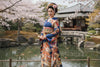




















Japanese patterns are fascinating because they are almost never merely decorative. On a textile, a screen, or a ceramic, they convey an idea, a season, a promise, or protection. This is particularly true in the world of Traditional Japanese Kimono, where the design is not just beautiful: it speaks, it situates, it suggests an intention.
This visual language, often referred to as wagara, remains very much alive. It can be found on ancient kimonos, in contemporary fashion, in stage costumes, in anime, and even in revisited pieces worn today in the West. The kimono remains an enduring symbol of Japanese culture and its textile history.
Understanding the symbolism of Japanese patterns therefore allows for a better interpretation of a garment, as well as a better choice of piece for oneself. This is useful for a women's kimono, a men's kimono jacket, a haori, a yukata, or even a satin kimono inspired by Japanese aesthetics.
What Does a Japanese Pattern Really Mean?
The term wagara refers to traditional Japanese patterns. The word combines the idea of what is Japanese, wa, with that of pattern or design, gara. In other words, it is not a vague style, but a precise visual vocabulary, formed over centuries. In common Japanese usage, the word gara indeed refers to the idea of a pattern or design.
This point is important, as a common misconception is to lump all Japanese prints together. However, a traditional pattern is not just "Japan-esque." It often has an ancient origin, an identifiable structure, cultural significance, and sometimes a use linked to a season, social status, or circumstance.
The first widely recognized wagara appeared as early as the Heian period in often geometric forms. Over time, they diversified, becoming more narrative, more refined, or more expressive. This explains why the same pattern can exist today in a very classic version on a Traditional Japanese Kimono or in a more modern interpretation on an everyday piece.
Why Patterns Matter So Much on Kimono
In Japanese textile culture, clothing does not separate aesthetics from meaning. The kimono can signal a season, an age, a celebration, an aspiration, or a moral quality. Patterns fully participate in this interpretation. They transform the fabric into a message, sometimes discreet, sometimes very legible.
Traditional Japanese clothing has long been linked to specific social uses. Fabrics, colors, the fineness of execution, and patterns could reflect rank, profession, situation, or occasion. This symbolic dimension became particularly structured during the Edo period, when dress codes tightened. Textiles then became a subtle ground for expression. This cultural reading of the kimono is widely highlighted by museum institutions and works on the history of Japanese costume.

This also explains why some designs are better suited to a flowing and ornamental women's kimono, while others are more appropriate for a more structured piece, a haori, or a men's kimono jacket. The pattern is not just a matter of taste: it influences the visual energy of the garment.
Another common misconception is to believe that a Japanese pattern always has a fixed meaning. In reality, the symbolic basis is stable, but uses evolve. A pattern can retain its traditional value while taking on a more aesthetic, fashionable, or personal interpretation today.
Major Japanese Patterns and Their Symbolism
The main Japanese patterns can be grouped into three broad families: patterns inspired by living things, geometric patterns, and patterns related to auspicious objects or signs. This framework helps to understand what one is truly wearing.
Plant Patterns: Season, Endurance, Prosperity
The sakura, or cherry blossom, evokes spring, ephemeral beauty, and softness. It is one of the most well-known patterns, often chosen for the grace it emanates as much as for its symbolic depth.
The matsu, or pine, symbolizes endurance, constancy, and wisdom. The take, or bamboo, expresses both strength, flexibility, and prosperity. The kiri, or paulownia, refers to honor and prestige. The asanoha, or hemp leaf pattern, is associated with rapid growth, resilience, and protection, especially for children.
In clothing, these plant motifs often give an impression of balance between refinement and vitality. On a women's kimono, they can create a presence that is both delicate and assertive.
Animal Patterns: Courage, Transformation, Longevity
The crane, or tsuru, is one of the most auspicious emblems: it evokes peace, longevity, and good fortune. The butterfly, or chô, speaks of transformation, continuity, and sometimes the memory of departed loved ones. The dragonfly, or tombo, is linked to courage and forward momentum, as it does not retreat in flight.
The chidori, a stylized small plover, expresses the idea of overcoming difficulties. The turtle, through the kikkô pattern inspired by its shell, refers to intelligence and longevity. As for the uroko pattern, formed by triangular scales, it is associated with protection, shedding, and thus the ability to leave behind what hinders one.
Geometric Patterns: Order, Peace, Progress
The seigaiha, made of concentric waves, is one of the most famous geometric patterns. It suggests the sea, but above all a calm strength, continuity, a peaceful life, and recurring good fortune.
The yagasuri, arrow pattern, symbolizes advancement and determination. The tatewaku, vertical wavy lines assimilated to rising steam, evokes elevation. The shippô, intertwined circles, expresses harmony and peace. The kagome, a hexagonal network inspired by a woven basket, speaks of balance and protection.
These geometric patterns have particular strength on understated pieces. They are well suited to a structured silhouette, especially on a men's kimono jacket or a more graphic haori.
Auspicious and Utilitarian Patterns
The sensu, stylized fan, is linked to prosperity and openness. The ajiro, fishing net, suggests abundance. The temari, inspired by ancient decorative balls, refers to friendship and loyalty. The karakusa, plant arabesque, evokes continuous growth and good luck.
These designs are valuable because they clearly show that Japanese symbolism does not oppose aesthetics and utility. An everyday object can become a pattern, then an auspicious sign.
A Social, Religious, and Aesthetic Language
Japanese patterns do not only refer to nature. They also reflect a social organization. During the Edo period, the way people dressed was strictly regulated. Common people often adopted plainer clothes with discreet patterns, while artisans, merchants, warriors, and nobles developed other codes, visible either in the quality of execution or in the symbolism itself.
Among the working classes, sashiko embroidery had a practical function of reinforcement, but also a protective meaning. Among samurai, certain simple patterns gained particular intensity: scales, turtle, dragonfly. In aristocratic circles, more complex or expensive-to-produce patterns, such as tatewaku, could signal a high rank.
This social dimension explains why a pattern is never purely decorative. Reading a fabric is often reading a hierarchy, a belief, or a way of situating oneself in the world. To delve deeper into the general history of Japanese clothing, the Victoria and Albert Museum's summary offers a good framework for interpretation. See the V&A resource.

It is also useful to note a point to avoid misunderstandings: Japanese symbolism is not always superimposable on Western symbolism. The chrysanthemum, for example, does not have the same connotation in Japan as in the French imagination. This is a classic mistake.
How These Patterns Are Still Alive Today
What makes Japanese patterns so current is their ability to transcend uses. They still live in traditional clothing, but also in fashion, illustration, object design, decoration, streetwear, and pop culture. Series like Demon Slayer have brought patterns like asanoha, ichimatsu, or uroko back into the spotlight, not as mere graphic nods, but as true markers of visual identity.
This continuity is not anecdotal. Institutions working on kimono remind us that this garment is not a static relic, but an object of constant creative evolution, capable of influencing both Japanese and Western fashion.
Today, wearing a Japanese pattern outside the strict framework of the kimono remains relevant, provided the design is not stripped of its meaning. A contemporary satin kimono or haori can very well incorporate an ancient pattern, provided that the composition, intention, and balance of the garment are coherent.
In this logic, the most geometric patterns often have great strength in everyday use, as they are easily integrated into a modern wardrobe. Floral or animal patterns, on the other hand, generally give a more narrative and emotional presence.
Choosing the Right Pattern for a Kimono, Haori, or Yukata
The best choice depends less on current fashion than on the desired effect. For a calming and fluid piece, seigaiha or shippô work very well. For a more determined look, yagasuri, kikkô, or uroko have a real presence. For a more poetic sensibility, sakura, butterfly, or crane remain strong references.
The support also matters. A yukata readily accepts more legible and seasonal patterns. A haori can easily accommodate structured or contrasting designs. A men's kimono jacket often gains strength with a sober repetitive pattern, while a women's kimono can accommodate more expansive and narrative compositions.
Finally, it is necessary to distinguish three similar but not identical things: the pattern, the cut, and the material. The same design will not produce the same effect on flowing silk, on yukata cotton, or on a brighter satin kimono. It is often this combination that makes a piece successful. To explore a more masculine and contemporary interpretation of these codes, you can discover our collection of men's kimono jackets.
FAQ on the Symbolism of Japanese Patterns
What is the difference between a Japanese pattern and a pattern simply inspired by Japan?
A traditional Japanese pattern generally has a recognized structure, history, and precise symbolism. A pattern only inspired by Japan may adopt certain visual codes without belonging to this ancient vocabulary.
Do all Japanese patterns have a positive meaning?
Overall, tradition mainly emphasizes favorable values: protection, longevity, peace, prosperity, growth, courage. Some patterns may be more ambivalent, but they are not designed as purely harmful signs.
Which pattern should I choose for a first kimono or haori?
To start, geometric patterns are often the easiest to wear: seigaiha, kikkô, shippô, or yagasuri. They remain visually strong while being simple to combine.
Is the asanoha pattern reserved for children's clothing?
No. Its link with healthy child growth is historical, but it is now worn far beyond that use. Its clear geometry and symbolic energy give it great modernity.
Do a yukata and a kimono feature the same patterns?
They can share certain patterns, but the effect changes depending on the season, material, and use. The yukata, being lighter and more summery, often features bolder, more visible, and more seasonal designs.
Where can I check the meaning of a Japanese term related to patterns?
For the definition of Japanese words themselves, a reference dictionary like Kotobank is a good starting point. For textile and historical context, specialized museum resources are more useful than a simple glossary.
Conclusion
The strength of Japanese patterns lies in their dual nature: they beautify, but they also mean something. In the world of Traditional Japanese Kimono, they connect the garment to nature, seasons, beliefs, social classes, and a certain idea of elegance. This is what makes them deeper than a simple print.
Understanding them changes the way one looks at a kimono, a haori, or a yukata. One no longer just sees a beautiful fabric: one reads an intention. And it is precisely this reading that still makes Japanese patterns so vibrant, so useful, and so modern today.