































In brief: To put on a modern kimono, slip on the sleeves without pulling on the fabric, center the garment on your shoulders, adjust the panels, and use the interior ties and sash if present. A kimono jacket can be worn open, while a dress or robe should be closed as designed. Traditional kimono rules do not automatically apply to modern styles.
The question “how do I put on a kimono?” depends first on the garment in question. Today, the term can refer to a flowy jacket, a wrap dress, a bathrobe, a beach kimono, a kimono abaya, or a traditional Japanese piece. Identifying the cut prevents you from forcing a closure that wasn’t intended or adding an unnecessary sash.
Which type of kimono do you want to put on?
- Kimono jacket: often worn open, short or mid-length, it is worn over an outfit.
- Kimono dress: a wrap or belted model intended to be closed.
- Kimono robe: loungewear with ties and a sash.
- Beach kimono: a lightweight piece worn open or loosely tied.
- Kimono abaya: a loose cut, worn open or belted depending on the model.
- Traditional kimono: a Japanese garment that adheres to specific dressing codes.
Look at the photos, belt loops, interior ties, and product description. A removable sash is not always intended to close the garment completely: it may simply serve to cinch the back or modify the style.

How to put on a modern kimono step by step?
- Prepare the outfit worn underneath. Choose a base suitable for the occasion: a top and trousers for a jacket, a swimsuit for a beach kimono, a lightweight outfit for an open abaya, or appropriate loungewear for a robe. A smooth base helps the fabric drape correctly.
- Slip on the sleeves without pulling. Slide one arm in and then the other. Avoid grabbing the edge of a sleeve to pull the entire garment, especially if the fabric is satin, flowy, or embroidered.
- Center the kimono on your shoulders. Adjust the collar or the back seam to the middle. Both sides should drape in a balanced way. On an oversized cut, the shoulder seam may intentionally drop.
- Adjust the front panels. Smooth each panel downward. For an open jacket, let them fall naturally. For a dress or robe, cross them in the direction intended by the ties and loops, without forcing the fabric.
- Fasten the interior ties. When the garment has them, first tie the inner panel’s tie with its opposite fastener. This step stabilizes the closure and prevents having to overtighten the outer sash.
- Position the sash. Thread it through the loops, position it at the intended height, then make a flat knot, a soft loop, or a side knot. The knot should hold the garment without compressing your waist.
- Check for comfort. Raise your arms, walk, and sit down. The collar should not rise excessively, the seams should not pull, and the sash should not restrict your breathing.
Should you wear the kimono open or closed?
Wearing a kimono jacket open
A kimono jacket, a beach model, or an open abaya can be worn without a sash. Let the panels follow a vertical line and ensure the underlying outfit remains balanced and visible. When the sash allows, you can also tie it in the back to keep the front open while providing more shape.
Closing a kimono dress or robe
First, use the interior ties, then cross the panels until you achieve comfortable coverage. Then, place the sash in its loops. Do not pull excessively on the outer panel to gain width: if the closure remains insufficient, the model or size is likely not suitable.
How to properly adjust the kimono's drape?
Shoulders
The garment should be centered. A loose cut may slide off the shoulder, but both sides should remain symmetrical.
Chest
On a closed model, the panels should cross without tension. On an open jacket, they should fall straight without being pushed toward the sides.
Sleeves
Check that they don't cover your hands to the point of being a nuisance and that you can bend your arms. A three-quarter or very wide sleeve may be a style choice, not a sizing error.
Length
A long kimono should allow you to walk without being tripped up. For a petite person, check the garment's length before trying to compensate solely with the sash.
What to wear under a modern kimono?
- A tank top and straight trousers under a jacket.
- A solid-colored dress under a long open kimono.
- A swimsuit under a beach kimono.
- A lightweight ensemble under an open kimono abaya.
- Suitable loungewear under a robe.
For more outfit ideas, check out our article: how to wear a kimono to enhance your silhouette.
How to put on a kimono for women or men?
For a woman
Start with the type of model rather than a gender-based rule. A jacket is easily worn open over jeans, a wrap dress uses its ties and sash, and a beach kimono is tied more loosely. Above all, check the length, the chest, and the sash placement.
For a man
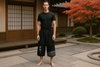
For a jacket or modern kimono, center the shoulders, adjust the sleeve length, and then wear it open or belted according to its design. On a loose model, do not compensate for a length that is too short by simply choosing a larger size.

How to put on a traditional Japanese kimono?
A traditional kimono differs from a modern garment inspired by the kimono. Putting it on may involve underlayers, ties, an obi, and specific rules for the type of garment and the occasion. For a living person, the left panel is placed over the right panel.
The Victoria and Albert Museum notes that a traditional kimono is a wrapped garment held by an obi. This cultural convention does not turn an open jacket, a dress, or a modern robe into a traditional outfit.
To understand the main categories, check out our article on the differences between yukata, haori, furisode, and kimono.
Mistakes to avoid
- Forcing an open jacket to close.
- Tightening the sash to compensate for a size that is too small.
- Ignoring the interior ties.
- Pulling on the sleeves to put on the garment.
- Confusing a modern kimono with a traditional outfit.
- Choosing solely based on width without checking the length.
- Allowing the two panels to fall asymmetrically.

FAQ: how do I put on a kimono?
Which way should I cross a modern kimono?
First follow the interior ties, loops, and the garment’s design. For a traditional Japanese piece worn by a living person, the left panel goes over the right panel. A modern open jacket does not need to be crossed.
Can you wear a kimono without a sash?
Yes, for a jacket, beach kimono, or open model. A dress or robe designed to be closed generally requires its ties or sash.
How do I keep a kimono from opening?
Fasten the interior ties before the sash, use the loops, and tie a flat knot. If the panels remain too far apart or pull, check the garment size rather than tightening it further.
How do I know if the kimono fits well?
The shoulders are balanced, the sleeves don't hinder you, the panels drape without tension, and you can comfortably sit or raise your arms. The result should remain consistent with the intended cut: fitted, flowy, or oversized.
Can you wear a kimono as a jacket?
Yes, when it is a modern model designed for layering. Wear it open over a simple base and check that the material and sleeves allow you to move without snagging the outfit underneath.
Putting on your kimono according to its actual design
The most important step is to respect the model in front of you. A kimono jacket is for layering, a dress is for wrapping, a robe uses its ties, and a traditional outfit requires a specific method. Browse our women's kimono and men's kimono collections, then check the size guide and details for each item before choosing your look.