


























Dressing a child in a Japanese kimono is not just about choosing a pretty garment. In Japan, traditional attire is a coherent whole where every detail—hairstyle, shoes, accessories—contributes to the overall harmony.
Today, whether it's for a party, a ceremony, a school event, or a photo shoot, more and more parents are looking for outfits inspired by Japan. But to achieve an elegant and authentic result, it's essential to understand the cultural codes that underpin it all.
In this article, we will see how to put together a complete and balanced look, focusing on hair accessories for little girls , suitable shoes and the little details that make all the difference.
Why hairstyle is essential with a girl's kimono
In Japanese culture, hairstyles are never merely an aesthetic detail. Historically, they indicate social rank, age, or marital status. Traditional hairstyles called nihongami, which emerged particularly during the Edo period, visually structure the face and silhouette.
As explained in the institutional article "The Art of Hairstyling in Japan" published by Web Japan, hairstyles have long been a strong cultural marker, still perpetuated today in kabuki theatre or among maiko (apprentice geisha) ( official source ).
For a child, the goal is obviously not to reproduce a complex historical hairstyle, but to respect this fundamental principle: the kimono calls for an elaborate and structured hairstyle.
Girls' hair accessories: tradition and elegance
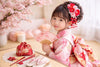
Hair accessories for girls are the centerpiece of the look. They frame the face, add color, and create visual balance with the kimono.
In Japanese tradition, hair ornaments are called kanzashi . They can represent seasonal flowers, butterflies, or natural elements. Among maiko, they even indicate the time of year.

A red floral accessory evokes the traditional ornaments worn during ceremonies. It immediately creates visual harmony with a floral-patterned kimono.
You can discover our complete collection of girls' hair accessories to create a hairstyle suitable for age and event.
Another, more discreet option: butterfly hair clips . The butterfly symbolizes transformation and lightness in Japanese aesthetics.

A hair clip adds an elegant touch without overwhelming the hairstyle. A common mistake is to use too many accessories: one statement piece is better than excessive decoration.
Girls' kimono: understanding the outfit to accessorize it well
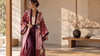
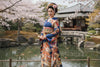
A girl's kimono is not a dress. It is distinguished by its straight cut, wide sleeves, and belt called an obi . The visual balance is based on verticality and symmetry.
Traditionally, the kimono structures the posture. The hairstyle extends this vertical line. That's why a simple low bun or a styled half-updo works particularly well.
To choose a model suitable for the age and the event, you can discover our collection dedicated to girls' kimonos .
It is important to distinguish between a costume and a traditional kimono. The former seeks immediate visual impact; the latter respects proportions and restraint.
Girls' shoes: the balance between tradition and comfort
In Japan, kimonos are traditionally worn with zōri (flat sandals) or geta (raised wooden sandals). For a child in the West, the goal is to maintain the aesthetic appeal while ensuring stability and comfort.
A flat, elegant, and well-fitting shoe for a girl is preferable to a model that is too stiff or slippery. Safety remains the priority.
You can discover our selection of girls' shoes suitable for traditional outfits.
Japanese fan and chopsticks: symbolic accessories
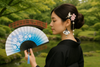
The Japanese fan is not just a decorative object. Historically, it has been used in dance, theater, and ceremonies. It extends gestures and adds a theatrical dimension to the outfit.
A decorative Japanese chopstick can be used in a staged scene or photoshoot, but it is not part of the outfit itself. It is important not to confuse a cultural accessory with a fashion accessory.
The difference is simple: the fan completes the silhouette; the baguette belongs more to the culinary and symbolic world.
Common mistakes to avoid
1. Overloading the hairstyle. Too many accessories disrupt the visual balance.
2. Mix Chinese and Japanese styles. The aesthetic codes are different.
3. Neglecting posture. The kimono calls for an upright and composed posture.
4. Ignoring the symbolism. Flowers and patterns often have a seasonal meaning.
Academic research on hairstyles in Asia demonstrates the profound connection between hair and social and cultural norms. The university thesis available on the HAL platform illustrates this socio-political dimension of hairstyles in an East Asian context. This symbolic depth explains why details matter.
FAQ – Dressing a girl in a Japanese kimono
What hair accessory should I choose for a girl's special occasion?
A floral accessory inspired by kanzashi remains a safe bet. It brings elegance and cultural coherence.
Can butterfly hair clips be used with a girl's kimono?
Yes, provided you keep it simple. A single, well-placed hair clip is enough.
Is it absolutely necessary to wear traditional Japanese shoes?
No. Comfort is paramount for a child. A stylish flat shoe is perfectly suitable.
Is a Japanese fan indispensable?
It is not mandatory, but it can enhance the aesthetics during a ceremony or photo shoot.
Conclusion
Dressing your daughter in a Japanese kimono is about creating a cohesive look where every detail has its place. The hairstyle frames the face, the hair accessories add a cultural dimension, and the shoes ensure stability and comfort.
By respecting these balances, you obtain an elegant, credible and timeless outfit — far beyond a simple disguise.