
























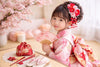








Why choose a children's kimono today?
The children's kimono is no longer reserved for Japanese ceremonies. Today, it is part of a modern wardrobe, serving as a comfortable garment, an aesthetic piece, and a strong cultural reference. It is appealing for special occasions as well as for daily use, particularly thanks to its fluid and enveloping cut.
Historically, the kimono accompanies the major milestones of childhood in Japan. During Shichi-Go-San, a rite celebrated at ages 3, 5, and 7, children wear traditional outfits marking their growth and their gradual entry into society (source Kotobank). This bond between clothing and a child's development remains very much present today.
In a Western context, choosing a kimono for a child means combining aesthetics, comfort, and symbolism without sacrificing practicality.
To explore different styles, you can discover our dedicated collection of children's kimonos.
The #1 criterion: comfort and freedom of movement
A child is constantly moving. They explore, run, climb, fall, and get back up. Their clothing should support these movements, not constrain them. This is even more true for a child's kimono, the cut of which can be poorly suited if it is too rigid or too tight.
Studies on motor development show that clothing should be soft, loose, and breathable so as not to hinder the child's natural motor skills. Fabric that is too tight or a restrictive cut can limit their movements and even hinder their breathing.
Therefore, a good children's kimono must:
- allow total freedom of movement in the arms and shoulders
- not compress the stomach or chest
- follow movements without resistance
This principle is especially important for a baby kimono, where freedom of movement is essential for development.

How to choose the right size for a child's kimono
Contrary to popular belief, buying a kimono that is too big is not a good strategy. If the garment is excessively long or wide, it becomes an obstacle: the child may trip over it, get tangled in the sleeves, or find it difficult to move around.
Conversely, a kimono that is too small limits movement and creates tension in the shoulders or stomach.
The right approach:
- choose a size adapted to the child's age and body type
- check the sleeve length (they should not cover the hands)
- ensure the belt (obi or equivalent) does not tighten
For a specific case like a 12-year-old girl's kimono, it is essential to check the proportions, as body types vary greatly at this age.
For suitable models, you can browse our selection of girl's kimonos.
Which materials should you prioritize for a child's kimono?
The choice of materials is crucial. It directly influences the comfort, breathability, and durability of the child's kimono.
Recommended materials
- Cotton: soft, breathable, ideal for daily use
- Linen: lightweight, perfect for summer
- Natural blends: a good compromise between structure and comfort
Materials to avoid
- stiff synthetic fabrics
- non-breathable materials
- fabrics that are too heavy for an active child
A good child's kimono should be light enough to accompany movement, while being strong enough for regular use.
What occasions is a child's kimono for?
The children's kimono is versatile today. It is no longer limited to traditional ceremonies.
Formal occasions
- family events
- cultural celebrations
- Japanese-inspired ceremonies
Daily use
- comfortable loungewear at home
- summer outings
- an original and lightweight look
In any case, the choice of model should be adapted to its use: more structured for an occasion, lighter for daily wear.

Girl's, boy's, or baby's kimono: what are the differences?
The differences between a girl's kimono, a boy's kimono, or a little girl's kimono are often aesthetic, but not solely.
Girl's kimono
- floral or colorful patterns
- sometimes a more fitted cut
Boy's kimono
- more sober colors
- geometric or traditional patterns
Baby kimono
- priority given to absolute comfort
- very soft materials
- easy to put on
For models adapted for boys, you can browse our collection of boy's kimonos.
Common mistakes to avoid
Certain choices can quickly make the kimono uncomfortable or unusable.
- choosing solely based on style
- ignoring fabric quality
- buying a size that is too big "to last"
- neglecting freedom of movement
A good child's kimono should always be designed as a functional garment before being an aesthetic one.
FAQ: Children's kimono
At what age can a child start wearing a kimono?
From the earliest age, provided that you choose a suitable, flexible model that is easy to put on.
Is a child's kimono comfortable for daily wear?
Yes, if it is well-cut and designed with suitable materials like cotton.
What is the difference between a kimono and a haori for children?
The kimono is a complete outfit, while the haori is a light jacket worn over the top.
Can a child's kimono be used as loungewear?
Absolutely. Its fluid cut makes it excellent, comfortable clothing for home.
Conclusion
Choosing a child's kimono is about finding the balance between aesthetics, comfort, and real-world use. A good model should support movement, fit the body, and suit the occasion.
Beyond the style, it is a garment that follows the child in their development. When well-chosen, it becomes both practical, pleasant to wear, and meaningful.